
Tobacco Labels in Asia-Pacific: Where the World’s Strictest Rules Meet Industry Resistance
Asia-Pacific is where tobacco control history gets made. Australia invented plain packaging. Thailand became the first Asian country to adopt it. Singapore was the first in Asia to put pictures on cigarette packs, back in 2004, when most of the world was still debating whether text warnings were enough.
But this region also shows what happens when governments waver. Myanmar has delayed plain packaging for 42 months and counting. In the Pacific Islands, nearly two-thirds of men in some countries still smoke daily. And across much of Asia, the tobacco industry continues to exploit every regulatory gap it can find.
Here’s what tobacco packaging looks like across the Asia-Pacific, country by country, with the rules, the loopholes, and the numbers that matter.
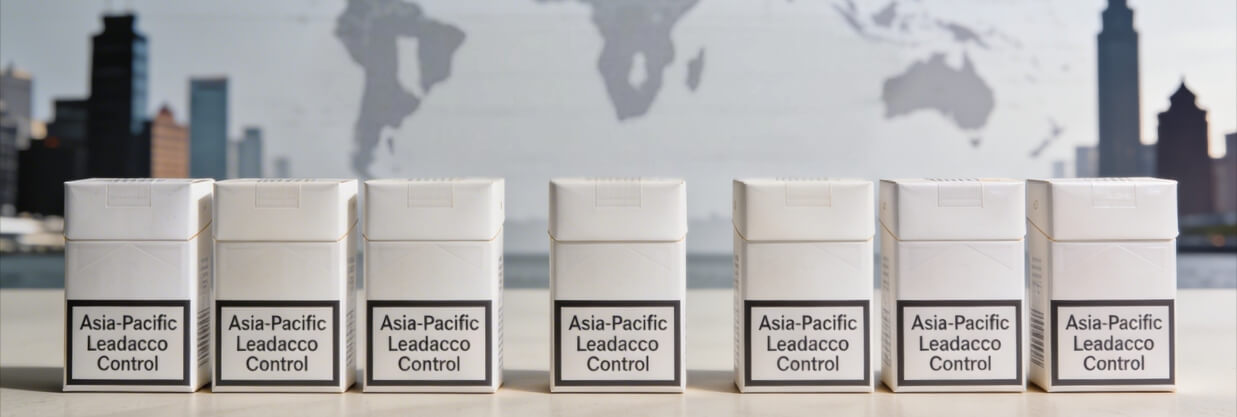
🇦🇺 Australia: The Country That Changed Everything
When Australia became the first nation to require plain packaging in December 2012, tobacco companies predicted disaster. Illicit trade would explode. Retailers would suffer. The policy would fail in court.
None of that happened.
Australian Cigarette Warnings Today
Australian cigarette packaging features the world’s first plain packaging system:
- Plain packaging: All tobacco products sold in drab brown (Pantone 448 C) with no logos, brand imagery, or promotional elements
- Warning size: Australian cigarette packet warnings cover 75% of the front and 90% of the back
- Graphic images: Large, full-colour pictures on cigarette packs in Australia show diseased lungs, mouth cancer, and other health consequences
- Brand display: Name only, in standardized Lucida Sans font
The government conducted post-implementation reviews that found plain packaging contributed to declining smoking rates without increasing illicit trade. Between 2012 and 2015, smoking prevalence dropped from 19% to 17%, with approximately 25% of that decline attributed directly to the packaging changes.
What’s Changing in 2025
Australia isn’t standing still. From July 2025, tobacco products face additional restrictions that go far beyond packaging:
Banned ingredients and flavours:
- Menthol
- Rum and clove flavourings
- Crush balls and flavour capsules
- Any additive that masks harshness or enhances addictiveness
Standardized products:
- Every cigarette pack must contain exactly 20 sticks
- Every roll-your-own pouch must contain exactly 30 grams
- Every carton must contain exactly 10 packs
- Cigarettes themselves must be uniform in length and width
- Unique filters are prohibited
Banned marketing terms:
- “Smooth,” “Gold,” and similar words that imply reduced harm
Health warnings on individual cigarettes:
- Australia became the second country in the world (after Canada) to require messages printed directly on every cigarette stick, effective April 2025
The changes address a stark reality: tobacco smoking remains the leading cause of preventable death in Australia, killing more than 24,000 people each year. That’s one person every 22 minutes.
🇹🇭 Thailand: Asia’s Plain Packaging Pioneer
Thailand has consistently punched above its weight in tobacco control. It was the fourth country in the world to require graphic warnings (2005) and the first in Asia to mandate plain packaging (September 2019).
Thailand Tobacco Packaging Requirements
The current requirements under Thailand’s Tobacco Products Control Act are among the world’s strictest:
Warning size: 85% of both front and back – the ninth largest in the world, tied with Hong Kong and India.
Plain packaging specifications:
- Drab brown colour (Pantone 448 C)
- Brand name in standardized font only
- No logos, imagery, or promotional elements
- Standardized pack shape and size
Side panel requirements: Thailand requires 10 different qualitative statements rotated across both side panels, providing additional health information beyond the main warnings.
Rotation: Warnings change every two years, with six rounds of updates since 2005.
How Thailand Got It Done
When Thailand announced its plain packaging timeline in December 2018, the tobacco industry had nine months to comply. They did.
This matters because it demolishes industry claims that compliance requires years of preparation. Thailand proved that when governments set firm deadlines and refuse to negotiate, tobacco companies find a way to meet them.
The Thai experience also demonstrates the effectiveness of comprehensive approaches. Plain packaging didn’t arrive in isolation – it built on decades of progressively stricter warnings, advertising bans, and smoke-free policies.
🇮🇳 India: Massive Warnings, Massive Challenges
India requires cigarette warnings covering 85% of both front and back panels matching Thailand and Hong Kong for the ninth largest in the world. For a country with over 1.4 billion people, the scale of this requirement is staggering.
India Cigarette Warnings: The Rules
Current requirements mandate:
- Warning size: 85% of principal display areas
- Position: Top of both front and back panels
- Content: Graphic images with text in English and one regional language
- Rotation: Warnings updated periodically with new images and messages
The warnings cover a range of health effects including cancer, heart disease, stroke, and impotence. India’s multilingual reality means warnings must work across dozens of languages, adding complexity to implementation.
The Bidi Challenge
India’s tobacco landscape includes bidis – hand-rolled cigarettes wrapped in tendu leaves that account for a significant portion of tobacco consumption, particularly in rural areas. Bidi packaging presents unique challenges:
- Smaller pack sizes make prominent warnings difficult
- Production often happens in small-scale, decentralised facilities
- Enforcement across thousands of producers is resource-intensive
Despite these challenges, India has extended warning requirements to bidis and continues strengthening enforcement.
Plain Packaging Consideration
India has not yet adopted plain packaging, but with 85% warnings already in place, the visual impact of current packs is substantial. Health advocates continue pushing for standardized packaging as the logical next step.
🇸🇬 Singapore: First in Asia, Still Leading
Singapore holds a unique place in Asia tobacco labels history. In 2004, it became the third country in the world, and the first in Asia, to require pictorial health warnings on cigarette packages.
Singapore Plain Packaging Timeline
Singapore adopted plain packaging in July 2020, making it the second Asian country after Thailand. The implementation was notable for its thoroughness:
- 12-month transition period: Manufacturers, wholesalers, and retailers all had clear deadlines
- Warning size increase: PHW coverage jumped from 50% to 75% simultaneously with plain packaging
- Comprehensive product coverage: Rules apply to cigarettes, cigarillos, cigars, beedies, ang hoon, and all roll-your-own products
Current Requirements
Singapore’s Tobacco (Control of Advertisements and Sale) Regulations specify:
Element | Requirement |
|---|---|
Warning size | 75% front and back |
Pack colour | Pantone 448 C (drab brown) |
Brand display | Standardized font, size, and position |
Side panel | Qualitative statement on chemicals |
Duty-free | Plain packaging required; duty-free sales banned for inbound travellers |
The side panel warning states: “Smoking exposes you and those around you to more than 4,000 toxic chemicals, of which at least 60 can cause cancer. The chemicals include tar, nicotine, carbon monoxide, formaldehyde, ammonia and benzene.”
Why Singapore Matters
Singapore demonstrates that plain packaging works in diverse Asian contexts. As a major regional hub with strong rule of law, Singapore’s successful implementation provides a model, and removes excuses, for other Asian countries considering similar measures.
The ASEAN Picture: Progress and Pushback
The Association of Southeast Asian Nations (ASEAN) presents a unique case study in tobacco labelling. It’s the only geopolitical region in the world where every single member state has implemented pictorial health warnings.
Current PHW Status Across ASEAN
Country | Warning Size | Position | Plain Packaging |
|---|---|---|---|
Thailand | 85% | Top | Yes (2019) |
Brunei | 75% | Top | No |
Myanmar | 75% | Top | Pending (delayed) |
Lao PDR | 75% | Top | Pending (delayed) |
Singapore | 75% | Top | Yes (2020) |
Malaysia | 65% | Top | No |
Cambodia | 55% | Top | No |
Indonesia | 50% | Top | No |
Vietnam | 50% | Top | No |
Philippines | 50% | Bottom | No |
The Philippines stands alone in placing warnings at the bottom of packages rather than the top – a positioning that reduces visibility and impact.
Four Countries, Four Approaches to Plain Packaging
Thailand (2019): Set a 9-month deadline. Industry complied. No extensions.
Singapore (2020): Set a 12-month deadline. Industry complied. No extensions.
Myanmar (originally 2022): Set a 6-month deadline. Industry lobbied for extensions. Now delayed by 42 months to October 2025.
Lao PDR (originally 2024): Set a 6-month deadline. Industry ignored it. Many manufacturers still non-compliant despite final government notice extending deadline to August 2025.
The contrast is instructive. Thailand and Singapore showed that firm government resolve produces industry compliance. Myanmar and Lao PDR show what happens when governments negotiate with an industry that has every incentive to delay indefinitely.
What the Delays Cost
Every month of delay means more exposure to tobacco marketing on packaging. For Myanmar, 42 months of delay represents nearly four years of preventable brand promotion. For Lao PDR, the SEATCA assessment is blunt: “Without zero tolerance for industry interference, progress will be slow and incomplete.”
The Missing Pieces
Most ASEAN countries still have significant gaps:
- Misleading descriptors: Brunei hasn’t yet banned terms like “light” and “mild”
- Tar/nicotine display: Only Brunei, Myanmar, and Thailand prohibit emission yields on packs
- Tax stamp placement: In Cambodia, Indonesia, Lao PDR, Malaysia, Myanmar, Thailand, and Vietnam, tax stamps partly cover health warnings
Regional Cooperation
ASEAN countries share health warning images through an image bank coordinated by the Southeast Asia Tobacco Control Alliance (SEATCA). This regional cooperation reduces costs and speeds implementation while ensuring culturally appropriate warnings.
New Zealand and the Pacific Islands
New Zealand adopted plain packaging in June 2018 and serves as a model for the broader Pacific region. But the Pacific Islands face tobacco challenges that statistics barely capture.
New Zealand’s warning requirements include:
- Plain packaging: Drab brown packs with standardized branding
- Warning size: 87.5% – making them the eighth largest in the world
- Rotation: Regular updates to maintain impact
- Smoke-free goal: Legislation passed in 2022 aimed to create a smokefree generation (though policy changes have since affected implementation)
The Pacific Islands Crisis
The Pacific Island Countries (PICs) face some of the world’s highest smoking rates combined with limited resources for tobacco control:
Adult daily smoking prevalence (men):
- Kiribati: 64.8%
- Papua New Guinea: 59.9%
- Solomon Islands: 50.2%
- Tuvalu: 46.9%
- Federated States of Micronesia: 39.8%
These aren’t just statistics. They represent populations where tobacco-related diseases (cancer, cardiovascular disease, diabetes) are leading causes of death.
Youth Smoking in the Pacific
Among 13–15-year-olds, current smoking rates are alarming:
Country | Boys | Girls |
|---|---|---|
Federated States of Micronesia | 43% | 24.4% |
Palau | 42.3% | 28.8% |
Kiribati | 37% | 22.5% |
Papua New Guinea | 34.9% | 18.2% |
The Tobacco-Free Pacific 2025 goal, reducing adult tobacco use below 5% in each country, has not been achieved.
E-Cigarettes: A New Threat
Data from Kiribati and Vanuatu show concerning e-cigarette use among youth:
- Vanuatu: 19.5% of youth use e-cigarettes – higher than the 14.2% who smoke tobacco
- Kiribati: 8.4% use e-cigarettes alongside 29.8% tobacco smoking
The Cook Islands responded by banning e-cigarettes entirely in 2024, prohibiting manufacture, import, sale, distribution, and advertising.
Plain Packaging Through Import
Two Pacific territories have plain packaging in practice without their own legislation:
- Cook Islands: Imports from New Zealand (plain packaging)
- Niue: Imports from Australia (plain packaging)
This demonstrates how small nations can benefit from larger neighbours’ policies.
Other Key Markets
Beyond Southeast Asia and the Pacific, several major East Asian markets illustrate how economic influence, state ownership, and regulatory caution shape tobacco packaging rules differently.
🇯🇵 Japan
Japan has historically maintained weaker tobacco control than other developed nations, partly due to the government’s stake in Japan Tobacco International. Current requirements include:
- Warning size: 30% of front and back
- Content: Text warnings; no graphic images required
- Plain packaging: Not adopted
Japan ranks among the lowest in warning coverage for developed countries.
🇲🇳 Mongolia
Mongolia requires graphic warnings covering 50% of packages. While not among the largest, Mongolia has shown commitment to tobacco control through comprehensive smoke-free legislation and advertising bans.
🇳🇵 Nepal
Nepal stands out globally with the world’s largest health warnings – 100% of principal display areas. This remarkable requirement demonstrates that even lower-income countries can implement world-leading tobacco control measures when political will exists.
🇰🇷 South Korea
South Korea requires:
- Warning size: 50% front and back (30% graphic image, 20% text)
- Position: Top of both panels
- Graphic images: Required since 2016
- Plain packaging: Under consideration
Industry Tactics Remain Consistent
Across the region, tobacco companies deploy familiar strategies:
- Demand endless proof: Insist on “more evidence” despite overwhelming research
- Predict catastrophe: Claim illicit trade will explode (it hasn’t in Australia)
- Seek delays: Lobby for timeline extensions (Myanmar: 42 months and counting)
- Exploit loopholes: When menthol cigarettes are banned, introduce menthol cigarillos
- Challenge in court: File intellectual property lawsuits (Australia won at WTO)
- Target emerging markets: Focus on Asia and Pacific where enforcement may be weaker
Understanding these tactics helps explain why some countries succeed (Thailand, Singapore) while others struggle (Myanmar, Lao PDR).