
Tobacco Labelling Regulations – Laws & Requirements by Country
Every cigarette pack you see carries a message. Some countries require small text warnings tucked at the bottom. Others mandate graphic images covering 90% of the package. This database tracks how 30+ countries regulate tobacco packaging, from health warning requirements to plain packaging laws.
What is Tobacco Labelling?
Tobacco labelling refers to the rules governments set for cigarette packaging. These rules dictate what information must appear on packs, how large warnings must be, and whether images are required.
The World Health Organization’s Framework Convention on Tobacco Control (WHO FCTC) sets the international baseline through Article 11. This article requires all member countries to place health warnings on tobacco packages within three years of ratifying the treaty. As of 2025, 183 parties have ratified the treaty.
Article 11 recommends warnings cover at least 50% of the pack’s principal display areas. Many countries exceed this. Nepal requires 100%, the largest in the world. Australia, Canada, India, and Thailand mandate 75–85%.
The science behind these requirements is simple: larger, graphic warnings make people think twice. Text-only warnings get ignored. Pictures of diseased lungs do not.
“Health warnings on tobacco packages are a cost-effective way to inform the public about health risks.” — WHO FCTC Guidelines
Tobacco Labelling by Region
Regulations vary dramatically across regions. Some areas lead global efforts. Others lag decades behind.
The Americas
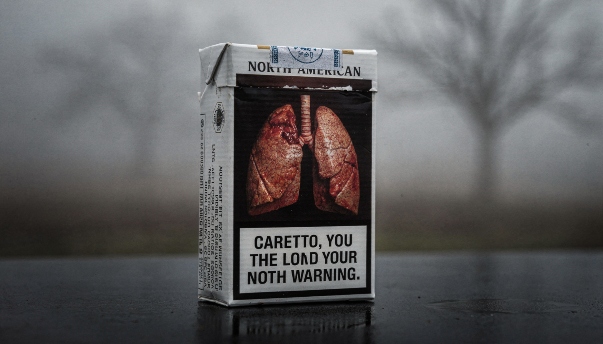
Canada pioneered graphic cigarette warnings in 2001. Today, Canadian cigarette packaging requires warnings on 75% of both front and back panels. Canada also became the first country in the world to require warnings on individual cigarettes (2024). The United States took until 2020 to finalize similar rules after years of legal battles. Brazil, Chile, and Uruguay have adopted some of the strictest requirements in the hemisphere.
Europe
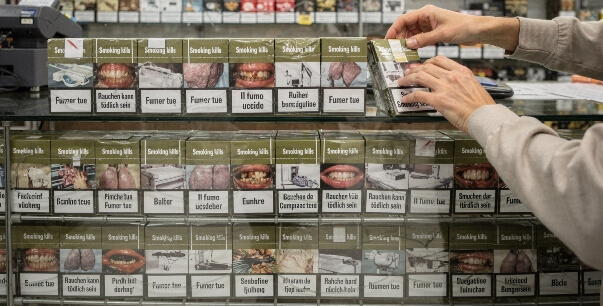
The European Union’s Tobacco Products Directive (TPD) standardizes rules across 27 member states. Warnings must cover 65% of the front and back. The UK, Ireland, and France have gone further with plain packaging. Additional EU countries, including the Netherlands, Denmark, Hungary, Slovenia, and Belgium have also adopted standardized packaging.
Asia-Pacific
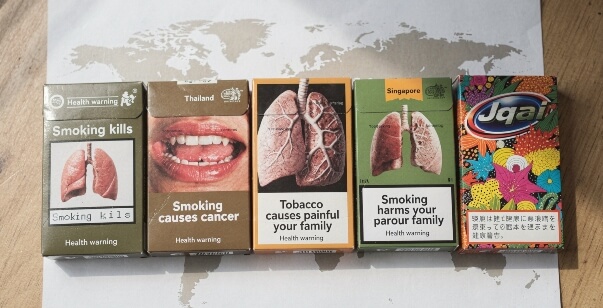
Australia became the first country to implement plain packaging in 2012. Thailand followed as the first Asian country to adopt plain packaging (2019). India requires 85% warnings, among the world’s largest. Singapore adopted standardized packaging in 2020. Japan remains an outlier with only 30% text-only warnings, among the smallest in developed nations.
Middle East and Africa
The Gulf Cooperation Council (GCC) countries share unified labelling standards. Turkey implemented plain packaging in 2019 (manufacturer deadline) and 2020 (retail), and requires the world’s second-largest warnings at 92.5%. Saudi Arabia and the UAE have also implemented plain packaging. Many African nations still lack comprehensive labelling and cigarette regulations in general, though Mauritius adopted plain packaging in 2023 and Côte d’Ivoire is scheduled for December 2025.
Region | Largest Warning Size | Plain Packaging Countries |
|---|---|---|
Americas | 80% (Uruguay) | Canada |
Europe | 65% (EU standard) | UK, Ireland, France, Belgium, Norway |
Asia-Pacific | 100% (Nepal) | Australia, New Zealand, Singapore |
Middle East & Africa | 92.5% (Turkey) | Turkey |
Cigarette Warning Labels
Research consistently shows that putting labels on cigarette packs, especially large pictorial warnings, increases awareness of smoking risks and reduces brand appeal. Studies published in Tobacco Control and BMJ confirm that pictorial warnings:
- Increase awareness of smoking risks
- Motivate quit attempts
- Discourage young people from starting
The most effective warnings show real health consequences. Images of mouth cancer, damaged hearts, and gangrene communicate risks faster than any text.
Countries experiment with different approaches. Some rotate warning images every 12–18 months to prevent wear-out. Others require quitline phone numbers or cessation resources directly on packs.
As of 2026, more than 140 countries require pictorial health warnings worldwide, covering approximately 66% of the world’s population.
Browse our health warning labels research section for studies, warning effectiveness data, and country-by-country comparisons.
Plain Packaging Policies
Plain packaging removes all brand colours, logos, and promotional elements from cigarette packs. Only the brand name remains, printed in a standardized font on a drab brown-green background (Pantone 448 C)..
Australia introduced the policy in December 2012. The tobacco industry challenged it in courts and through international trade disputes. Australia won every case.
Since then, plain packaging has spread to:
- Australia (December 2012) – world’s first
- United Kingdom (May 2017)
- France (January 2017)
- Ireland (September 2018)
- New Zealand (June 2018)
- Norway (July 2018)
- Thailand (September 2019) – first in Asia
- Turkey (December 2019)
- Canada (February 2020)
- Singapore (July 2020)
- Belgium (January 2021)
- Saudi Arabia, UAE – implemented
- Mauritius (March 2023) – among first in Africa
Evidence from Australia, UK, and other countries shows the policy reduces brand appeal, increases attention to health warnings, and contributes to declining smoking rates.
See our plain packaging policies page for implementation timelines, legal challenges, and research findings.
Research and Resources
This database compiles information from government health departments, WHO reports, and peer-reviewed research. We link directly to primary sources whenever possible.
Key resources include:
- WHO FCTC Article 11 Guidelines – official treaty text and implementation guides
- Canadian Tobacco Package Health Warnings – Health Canada’s current requirements
- EU Tobacco Products Directive – European Commission documentation
Frequently Asked Questions
What is WHO FCTC Article 11?
Article 11 of the WHO Framework Convention on Tobacco Control requires countries to place health warnings on tobacco packages. It recommends warnings cover at least 50% of principal display areas and include pictures or pictograms.
Which countries have the largest health warnings?
Nepal leads with 100% coverage – the world’s largest. Other countries requiring 80% or more include Timor-Leste and Turkey (92.5%), Vanuatu and Mauritius (90%), and India and Thailand (85%). Australia and Canada require 75%.
What are graphic health warnings?
Graphic health warnings use photographs or illustrations showing the health effects of smoking. Common images depict diseased lungs, mouth cancer, or the impact of second-hand smoke on children.
What is plain packaging for cigarettes?
Plain packaging standardizes the appearance of all cigarette packs. Brands cannot use distinctive colours, logos, or fonts. All packs look identical except for the brand name in a prescribed typeface.
How effective are tobacco labels?
Research shows graphic warnings increase risk awareness by 15–20% compared to text-only warnings. They also prompt more quit attempts, particularly among younger smokers. Long-term studies show these effects persist over years when combined with plain packaging.
What percentage of cigarette packs must show warnings?
Requirements range from 30% in some countries to 100% in Nepal. The WHO recommends at least 50%. Most developed nations now require 65–85%.
This is an independent educational resource. We are not affiliated with any government, university, or previous website operators. Information is compiled from publicly available official sources, including WHO, CDC, and government health departments.
Last updated: February 2026.