
Global Tobacco Labelling Laws
Tobacco labelling laws dictate what appears on cigarette packs. These regulations vary from country to country, but most follow a common framework established by the World Health Organization.
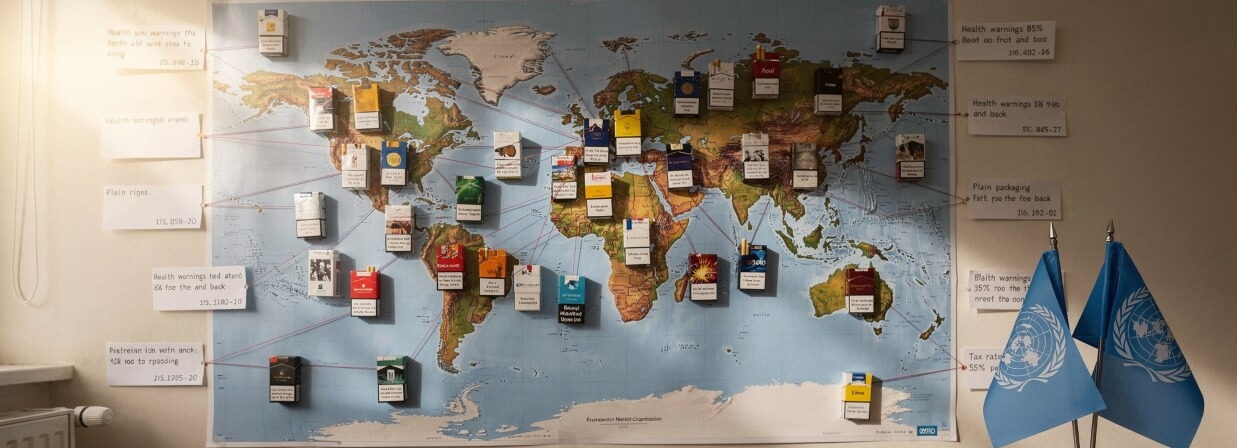
This page covers the international standards, key regulatory bodies, and how different nations approach cigarette packaging regulations. Use it as a world map of tobacco labelling laws to compare requirements across 180+ countries.
International Standards for Tobacco Labels
The WHO Framework Convention on Tobacco Control (FCTC) shapes tobacco regulations worldwide. Adopted in 2003 and entering into force in 2005, the FCTC remains the first international public health treaty negotiated under WHO auspices.
As of November 2025, the WHO FCTC has 183 Parties, representing more than 90% of the world’s population.
The FCTC addresses tobacco control through several articles:
Article | Focus Area |
|---|---|
Article 8 | Protection from tobacco smoke exposure |
Article 9 & 10 | Regulation of tobacco product contents and disclosures |
Article 11 | Packaging and labelling of tobacco products |
Article 12 | Education and public awareness |
Article 13 | Tobacco advertising, promotion, and sponsorship bans |
Under Article 11, Parties must adopt effective packaging and labelling measures within three years of the treaty entering into force for them, including health warnings that cover at least 30% of the principal display areas.
WHO FCTC Article 11 Requirements
Article 11 establishes minimum standards for tobacco packaging worldwide. The requirements include:
- Health warnings must cover at least 30% of the principal display areas. The FCTC guidelines recommend 50% or more. Many countries now exceed this, with some reaching 80–90%.
- Warnings should describe the harmful effects of tobacco use. Terms like “light,” “mild,” or “low tar” are prohibited because they mislead consumers into thinking some cigarettes are safer than others.
- Countries should consider using pictures or pictograms in their warnings. Research confirms graphic warnings outperform text-only messages.
- Warnings must be rotating. Displaying the same image indefinitely reduces impact. Most countries rotate warning sets every 12–36 months.
The FCTC also encourages plain packaging, though this remains optional. Countries like Australia, Canada, and the United Kingdom have adopted standardized packaging laws.
“Parties should consider adopting measures to restrict or prohibit the use of logos, colours, brand images or promotional information on packaging other than brand names and product names.” — FCTC Article 11 Guidelines
How Countries Regulate Tobacco Packaging
Despite the FCTC framework, tobacco regulations differ substantially across regions. Some countries mandate warnings covering 90% of the pack. Others still permit small text-only labels.
Country/Region | Warning Size | Pictorial Required |
|---|---|---|
Nepal | 90% | Yes |
India | 85% | Yes |
Thailand | 85% | Yes |
Australia | 82.5% | Yes (plain packaging) |
Canada | 75% | Yes |
European Union | 65% | Yes |
United States | 50% | Yes |
Japan | 30% | No |
China | 35% | No |
Regional Approaches
The Americas show wide variation. Canada requires graphic warnings covering 75% of the front and back of cigarette packs. The United States’ FDA issued a final rule in March 2020 that requires new cigarette package warnings covering 50% of the front and back, but implementation has been delayed by litigation and the FDA’s current enforcement policy runs into late 2025–early 2026. Uruguay increased pictorial warnings to 80% of the front and back in 2009–2010.
European countries follow the EU Tobacco Products Directive, which mandates 65% combined warnings. Several nations have added plain packaging on top of these requirements.
Asia‑Pacific nations range from strict (Australia, Thailand, Nepal) to weaker packaging rules (for example, Japan’s text‑only warnings). Indonesia expanded its graphic warnings from 40% to 50% in 2024. Australia’s 2012 plain packaging law became a global model.
Middle Eastern and African countries often follow regional standards. GCC countries share unified labelling requirements across member states, including Saudi Arabia, UAE, and Bahrain.
What You See on a Cigarette Pack
Modern tobacco labelling regulations typically require:
- Health warnings (text and/or images)
- Information on constituents/emissions (many countries prohibit quantitative yield numbers like “tar/nicotine/CO”; some require qualitative statements or disclosures on side panels)
- Cessation information (quitline numbers, websites)
- Age restriction notices
- Product identification (brand, manufacturer)
What regulations prohibit:
- Misleading descriptors (“light,” “mild,” “natural”)
- Health claims or implied reduced risk
- Flavour descriptions that appeal to youth (in some jurisdictions)
- Promotional elements on plain packaging packs
Key Regulatory Bodies
Several organizations shape global tobacco control policy and monitor compliance with labelling requirements.
World Health Organization (WHO)
The WHO tobacco control efforts centre on the FCTC, administered through the Convention Secretariat based in Geneva. The organization publishes implementation guidelines, tracks country progress, and provides technical assistance to member states.
The WHO FCTC Conference of the Parties (COP) meets every two years to review treaty implementation and adopt new guidelines.
National Health Ministries
Each country implements tobacco regulations through its health ministry or equivalent agency:
- Health Canada oversees Canadian cigarette brands and packaging requirements
- The U.S. Food and Drug Administration regulates tobacco products in America
- The European Commission coordinates tobacco control across EU member states
- Australia’s Department of Health manages the world’s first plain packaging regime.
Regional Bodies
The European Union sets baseline standards through the Tobacco Products Directive (2014/40/EU). Member states may exceed these requirements but cannot fall below them.
The Gulf Cooperation Council Standardization Organization (GSO) publishes unified technical regulations for GCC countries. This includes labelling standards applied across Saudi Arabia, UAE, Kuwait, Qatar, Bahrain, and Oman.
The Southeast Asia Tobacco Control Alliance (SEATCA) advocates for stronger regulations in ASEAN nations and monitors tobacco industry interference.
Research Institutions
Academic centres contribute evidence that shapes policy:
- The University of Waterloo’s School of Public Health has published extensive research on warning label effectiveness
- The Johns Hopkins Bloomberg School of Public Health tracks global tobacco control policies
- Cancer Council Victoria (Australia) evaluates plain packaging outcomes.
Major Changes in Tobacco Labelling
Major milestones in global cigarette labelling laws and regulations:
Date | Event |
|---|---|
2001 | Canada becomes the first country to require pictorial (graphic) health warnings on cigarette packages. |
21 May 2003 | WHO FCTC adopted by the World Health Assembly. |
27 Feb 2005 | WHO FCTC enters into force; Article 11 sets minimum packaging/labelling standards (30% minimum warning size; guidelines recommend 50%+ and placement at the top). |
2012 | Australia implements plain (standardized) packaging (first in the world). |
20 May 2016 | EU Tobacco Products Directive health warnings (65% combined warnings for cigarettes and roll-your-own) become applicable in EU Member States. |
2019 | Canada implements plain packaging (standardized packaging) alongside its existing large pictorial warnings. |
2024 | Canada begins requiring health warnings printed directly on individual cigarettes (phased implementation). |
17–22 Nov 2025 | COP11 (11th Conference of the Parties to the WHO FCTC) takes place in Geneva. |
2025 | WHO releases the Global Tobacco Epidemic 2025 report; Canadian Cancer Society publishes its 2025 international status report on warnings and plain packaging. |
Current Statistics
- The WHO Framework Convention on Tobacco Control now counts 183 Parties, covering more than 90% of the global population.
- 140 countries and territories mandate graphic (pictorial) health warnings on cigarette packaging, reaching about 66% of people worldwide.
- Standardized (plain) packaging has been formally adopted in 27 jurisdictions, while 44 in total are at different stages of implementation or legislative progress.
- In 130 countries and territories, health warnings must occupy at least 50% of the front and back of cigarette packs (on average).
- 77 jurisdictions require warnings covering 65% or more, and 11 mandate coverage of 85% or higher.
Tobacco consumption continues to rank among the leading preventable causes of early death, responsible for more than 7 million fatalities each year. Packaging and labelling measures form one essential pillar within broader, evidence-based tobacco control strategies.
The content on this page is provided for general informational and educational purposes only. While we strive for accuracy, tobacco regulations change frequently, and information may not reflect the most current legal requirements in any given jurisdiction. This site does not constitute legal, medical, or professional advice. Always consult official government sources or qualified professionals for country-specific regulatory guidance.