
Plain Packaging for Cigarettes: How It Works and Where It’s Required
In 2012, every cigarette pack in Australia started looking the same. No logos. No colours. No brand imagery. Just a drab brown-green box with graphic health warnings covering most of the surface. The tobacco industry called it an attack on intellectual property. Public health advocates called it a breakthrough. Today, 27 countries have adopted plain packaging for cigarettes following Australia’s lead.
The Idea Behind Plain Packaging
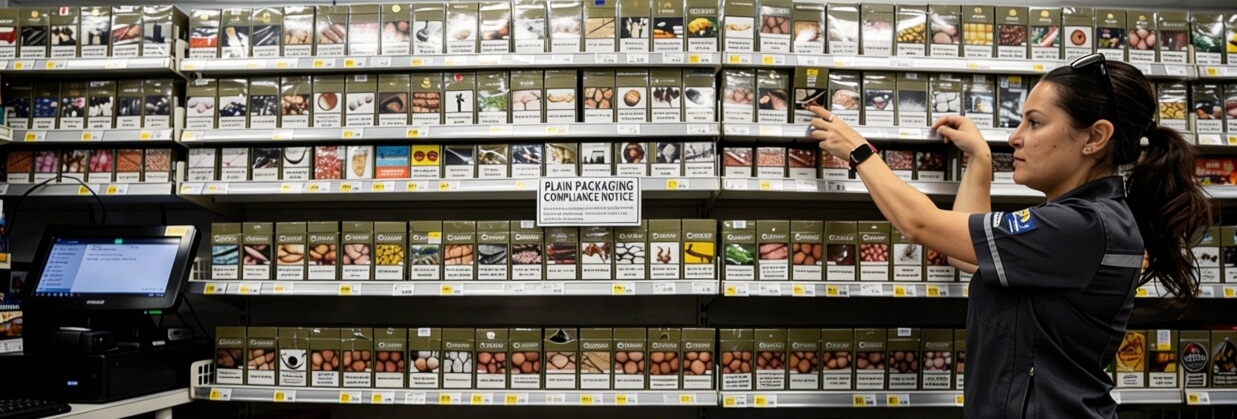
Plain packaging (also called generic or standardized packaging) strips all branding from cigarette packs. No distinctive colours, no logos, no promotional design elements. The only things that remain are the brand name in a mandated font, health warnings, and legally required information like tax stamps.
Every pack looks identical except for the product name. The background colour is the same drab brown-green across all brands. In Australia, researchers tested hundreds of colours to find the least appealing one. They settled on Pantone 448 C, officially renamed “drab dark brown” after the Australian Olive Association complained about its original name.
The policy targets three mechanisms:
Reducing appeal. Cigarette packs function as miniature billboards. Brands invest heavily in cigarette pack design to communicate lifestyle associations, premium positioning, and target demographics. Remove the design, and you remove a key marketing channel.
Increasing warning effectiveness. Without competing brand imagery, health warning labels become more prominent. Studies show smokers notice warnings more frequently on plain packs.
Eliminating misleading cues. Lighter colours and sleek designs can suggest reduced harm. Tobacco branding regulations like plain packaging remove these visual signals that mislead consumers about relative risk.
Which Countries Require Plain Packaging?
As of late 2025, 27 plain packaging countries and territories have adopted these laws. Another 14 are actively considering implementation, and 3 have it in practice through imports.
Countries with Plain Packaging (by year implemented)
Year | Countries |
|---|---|
2012 | Australia |
2016 | France, United Kingdom |
2017 | Norway, Ireland |
2018 | New Zealand |
2019 | Saudi Arabia, Turkey, Thailand, Canada, Uruguay |
2020 | Slovenia, Belgium, Israel, Singapore, Netherlands |
2021 | Denmark, Guernsey |
2022 | Hungary, Jersey |
2023 | Finland, Mauritius |
2024 | Oman |
2025 | Georgia, Laos, Côte d’Ivoire, Myanmar |
2027 | Iceland, Syria (scheduled) |
Note: Years indicate when plain packaging requirements first took effect. Some countries allow transition periods for retail sales.
Three additional territories have plain packaging in practice because they import cigarettes from countries that require it: Monaco (from France), Cook Islands (from New Zealand), and Niue (from Australia).
Countries formally considering plain packaging include Armenia, Botswana, Colombia, Costa Rica, Czechia, Fiji, Hong Kong, Iran, Malaysia, Mexico, Panama, Russia, and South Africa.
Regional Data
Among plain packaging countries, Europe leads adoption with 12 nations: UK, France, Ireland, Norway, Belgium, Netherlands, Slovenia, Denmark, Hungary, Finland, Guernsey, and Jersey.
Asia-Pacific includes Australia (the pioneer), New Zealand, Thailand, Singapore, Laos, and Myanmar.
Middle East has Saudi Arabia, Turkey, Oman, and upcoming Syria.
Americas counts Canada and Uruguay, with several Latin American countries considering adoption.
Africa now has Mauritius and Côte d’Ivoire, making it the continent with two plain packaging countries as of 2025.
How Australia Started It All
Australia’s Tobacco Plain Packaging Act 2011 took effect on December 1, 2012. The law required all tobacco products sold in Australia to use standardized packaging with no brand colours, logos, or imagery.
The policy combined plain packaging with enlarged graphic health warnings covering 75% of the front and 90% of the back of each pack. Brand names appear in a standard font (Lucida Sans) in a specified size and position.
The Australian government selected the pack colour through consumer research. Pantone 448 C tested as the colour least likely to be associated with positive qualities. Focus groups described it as “dirty,” “death,” and “tar.”
Implementation faced massive resistance. Tobacco companies launched legal challenges, lobbying campaigns, and international trade disputes. Australia won every case.
What Happened After Australia
Post-implementation research documented several effects:
Smokers reported cigarettes as less satisfying. Studies found that smoking from plain packs was perceived as a less enjoyable experience, even though the cigarettes inside were identical.
Quit attempts increased. Tracking surveys showed more smokers thinking about quitting and more calls to the Quitline. Research documented a 78% increase in Quitline calls associated with plain packaging introduction.
Youth appeal declined. Surveys of adolescents from 2011 to 2017 showed tobacco continued to be viewed as less appealing, with students more uncertain about tobacco brands.
Warning salience improved. The ITC Project found that after plain packaging, smokers showed increased attention toward warnings and more thoughts about the harms of smoking.
The Legal Battles
No tobacco control policy has faced more legal challenges than cigarette pack design laws like plain packaging. The tobacco industry deployed every available avenue: domestic courts, international investment tribunals, and World Trade Organization disputes.
Australia’s Court Victory
Philip Morris Asia filed an investor-state dispute against Australia in 2011, claiming the policy violated a bilateral investment treaty with Hong Kong. The case was dismissed in December 2015 on jurisdictional grounds.
Domestically, British American Tobacco, Philip Morris, Imperial Tobacco, and Japan Tobacco International challenged the law in Australia’s High Court, arguing it amounted to the acquisition of their intellectual property without compensation. In August 2012, the High Court ruled 6-1 in favour of the government. The policy was constitutional.
WTO Disputes
Honduras, Dominican Republic, Cuba, and Indonesia filed complaints at the World Trade Organization, arguing plain packaging violated international trade agreements. In June 2018, a WTO panel ruled that Australia’s measures were justified as necessary to protect public health. The panel concluded that plain packaging restricts trade only insofar as it reduces consumption, which is the legitimate objective of the measure. In June 2020, the Appellate Body rejected an appeal from Honduras and the Dominican Republic.
UK Litigation
When the United Kingdom implemented plain packaging, tobacco companies challenged the regulations in court. In May 2016, the High Court dismissed all claims. The Court of Appeal upheld the decision, and the Supreme Court denied permission to appeal.
The pattern repeated across countries. Legal challenges to cigarette pack design laws delayed but did not stop implementation. Courts consistently ruled that public health interests justified the restrictions on tobacco marketing.
Does Plain Packaging Work?
The evidence comes from multiple sources: government tracking surveys, independent academic research, and international comparative studies.
Smoking Rates
Australian smoking prevalence continued declining after plain packaging implementation. Daily smoking among adults fell from 15.1% in 2010 to 11.0% in 2019. Smoking among Australian teenagers (12–17 years old) decreased from 3.4% in 2013 to 1.5% in 2016. For 18–19-year-olds, rates dropped from 10.8% to 4.6% over the same period.
Isolating the specific effect of plain packaging from other tobacco control measures (price increases, advertising bans, smoke-free laws) remains methodologically challenging, but research indicates the policy contributes to overall declines.
Pack Appeal and Brand Identification
Research consistently shows plain packaging reduces the appeal of cigarette packs, particularly among young people. Smokers have more difficulty identifying premium versus budget brands. Tobacco branding regulations like plain packaging remove a key mechanism by which companies differentiate products and target demographics.
Warning Effectiveness
Studies from Australia, the UK, and France document increased attention to health warnings on plain packs. Without brand imagery to compete for attention, warnings become more salient. See our health warning labels research page for detailed findings.
Systematic Reviews
A 2025 systematic review examining plain packaging policies across countries identified the main barriers to adoption (legal challenges, economic arguments, and tobacco industry framing) and facilitators (government preparation, coordination, and strategic communication). The review confirms that implemented policies achieve their stated objectives.
The Next Step: Warnings on Individual Cigarettes
Canada became the first country to require health warnings printed directly on individual cigarettes, with regulations taking effect August 1, 2023, and full implementation by April 2025. Australia followed in 2025.
The measure addresses a gap in tobacco labelling: cigarettes sold individually (common in some low-income countries) bypass package warnings entirely. Even where cigarettes are sold in packs, warnings on each cigarette reach smokers at the moment of consumption.
Messages like “Poison in every puff” and “Cigarettes cause cancer” now appear on individual Canadian cigarettes. The warnings cannot be avoided by discarding the pack or using a cigarette case.
Expanding Plain Packaging Beyond Cigarettes
Several countries are extending plain packaging requirements to additional tobacco products. Belgium announced in August 2025 that cigars, cigarillos, cigarette papers, filters, tubes, and herbal smoking products must adopt standardized packaging effective June 1, 2026. The Netherlands similarly expanded requirements to e-cigarettes and cigars effective July 2025.
This expansion addresses loopholes that allow tobacco companies to market through products not covered by the initial cigarette-focused regulations.
This is an independent educational resource. We are not affiliated with any government, university, or previous website operators. Information is compiled from publicly available official sources, including WHO, government health departments, and peer-reviewed research.