
Tobacco Labels in the Americas, by Country
Cigarette packaging regulations vary wildly across North, Central, and South America. Canada leads the world with warnings printed directly on individual cigarettes. The United States still uses the same text warnings from 1984. Mexico bans all tobacco displays in stores. Uruguay won a six-year legal battle against Philip Morris.
On this page, we cover what appears on cigarette packs in each country, who regulates it, and where the laws are heading.
🇨🇦 Canada: Setting Global Standards Since 2001

Canada has been at the forefront of tobacco control for over two decades. In 2001, it became the first country in the world to require graphic picture warnings on cigarette packages. In 2024, it became the first to require health warnings printed directly on individual cigarettes.
What Canadian Cigarettes Look Like Today
Every cigarette pack sold in Canada must meet requirements under the Tobacco Products Appearance, Packaging and Labelling Regulations (TPAPLR), which came into force on August 1, 2023. These regulations consolidated three previous sets of rules into one framework.
Canada cigarette packs display warnings covering 75% of the package. The country uses two series of 14 and 13 warnings that rotate every 24 months to keep messages fresh and prevent “wear-out” among smokers. Canadian smoking warnings include graphic images and cessation information.
Plain packaging has been required since February 2020. All Canadian cigarette brands must use the same drab brown colour (Pantone 448 C), with brand names displayed only in a standardised Lucida Sans font. No logos, colours, or promotional imagery.
Warnings on individual cigarettes began appearing at retail in July 2024 for king size cigarettes, with regular size cigarettes following by April 2025. Canada uses two sets of six warnings that include messages like “Poison in every puff” and “Cigarettes cause cancer.”
Cigarette Brands in Canada: Standardised Appearance
The regulations strictly control what cigarette brands Canada can display. Slim and superslim cigarettes are effectively banned through dimension requirements:
Specification | Requirement |
|---|---|
Diameter | 7.65–8.0 mm |
Regular size length | 70.0–73.0 mm |
King size length | 82.0–85.0 mm |
Filter colour | White only |
Paper | White, matte finish |
Tipping paper | White or cork imitation, matte |
These specifications eliminate the sleek, slim packaging that tobacco companies used to target young women.
Health Information Messages
Beyond the exterior warnings, cigarette packages must contain health information messages inside. These focus on cessation benefits and provide tips for quitting. The regulations require 13 interior messages in two sets, rotating every 24 months.
Each pack also includes a toll-free pan-Canadian quitline number (1-866-366-3667) and a website linking smokers to provincial cessation services.
Why Canada Tobacco Warnings Matter
The numbers tell the story. Approximately 48,000 Canadians die annually from tobacco-related illnesses. The health and economic costs were estimated at $12.3 billion in 2017. Canada’s aggressive labelling approach reflects decades of evidence that graphic warnings reduce smoking rates and increase quit attempts.
Eighteen major Canadian health organisations endorsed plain packaging before its implementation, including the Canadian Cancer Society, Canadian Medical Association, Heart and Stroke Foundation, and Canadian Lung Association.
🇺🇸 United States: Four Decades of Inaction
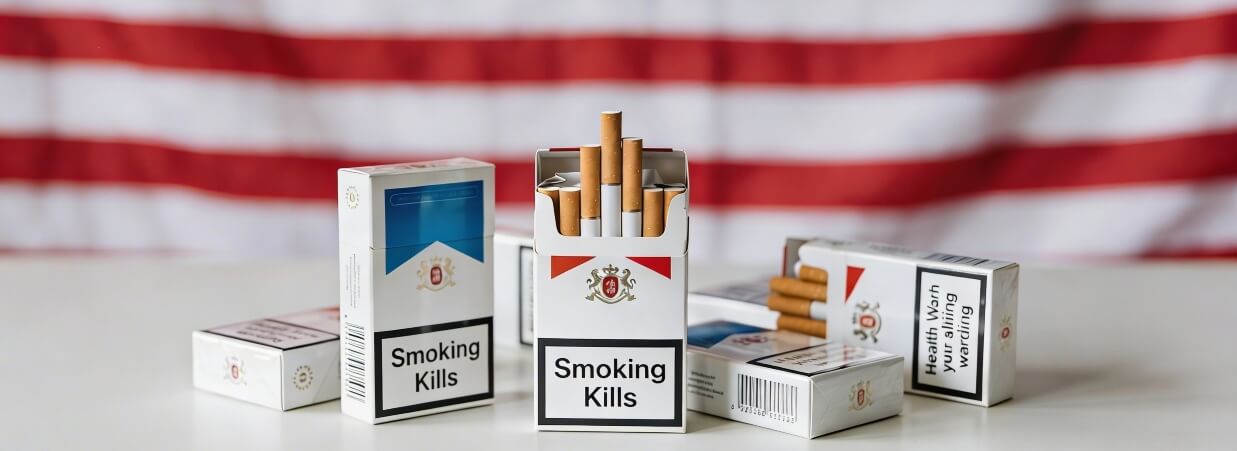
The United States was the first country in the world to require health warnings on cigarette packages, starting in 1966. Nearly sixty years later, it ranks 173rd globally for warning size – tied for last place.
US Cigarette Warnings: Still Stuck in 1984
American cigarettes still carry the same Surgeon General’s warnings introduced in 1984. These text-only warnings appear in small type along the side of the pack, often matching the package design so they blend in rather than stand out.
The current warnings include four rotating messages:
- SURGEON GENERAL’S WARNING: Smoking Causes Lung Cancer, Heart Disease, Emphysema, And May Complicate Pregnancy.
- SURGEON GENERAL’S WARNING: Quitting Smoking Now Greatly Reduces Serious Risks to Your Health.
- SURGEON GENERAL’S WARNING: Smoking By Pregnant Women May Result in Fetal Injury, Premature Birth, And Low Birth Weight.
- SURGEON GENERAL’S WARNING: Cigarette Smoke Contains Carbon Monoxide.
The Fight Over Graphic Warnings
In 2009, Congress passed the Family Smoking Prevention and Tobacco Control Act, directing the FDA to require colour graphic warnings covering 50% of cigarette packages. The FDA’s first attempt in 2011 was struck down by the D.C. Circuit Court on First Amendment grounds.
The FDA tried again in March 2020, finalising a rule for 11 new graphic warnings depicting health consequences like lung cancer, heart disease, cataracts, and erectile dysfunction. These warnings would cover 50% of the front and back of packages, plus 20% of advertisements.
Timeline of legal challenges:
Date | Event |
|---|---|
March 2020 | FDA finalises graphic warning rule |
December 2022 | Texas district court vacates the rule |
March 2024 | Fifth Circuit reverses, upholds constitutionality |
January 2025 | Texas district court issues preliminary injunction |
August 2025 | Georgia district court vacates the rule |
October 2025 | FDA appeals to Eleventh Circuit |
As of late 2025, no graphic cigarette warning labels are required on US cigarette packages. Litigation continues in multiple federal courts.
What the New Warnings Would Show
The FDA’s 11 approved warnings include:
- WARNING: Smoking causes head and neck cancer.
- WARNING: Tobacco smoke causes fatal lung disease in nonsmokers.
- WARNING: Smoking causes cataracts, which can lead to blindness.
- WARNING: Smoking reduces blood flow, which can cause erectile dysfunction.
- WARNING: Tobacco smoke can harm your children.
- WARNING: Smoking causes bladder cancer, which can lead to bloody urine.
- WARNING: Smoking reduces blood flow to the limbs, which can require amputation.
- WARNING: Smoking causes COPD, a lung disease that can be fatal.
- WARNING: Smoking causes type 2 diabetes, which raises blood sugar.
- WARNING: Smoking during pregnancy stunts fetal growth.
- WARNING: Smoking can cause heart disease and strokes by clogging arteries.
If the FDA ultimately prevails in court, implementation would likely include a transition period. If the rule is permanently vacated, developing new regulations could take years.
🇲🇽 Mexico: Comprehensive Restrictions Since 2022
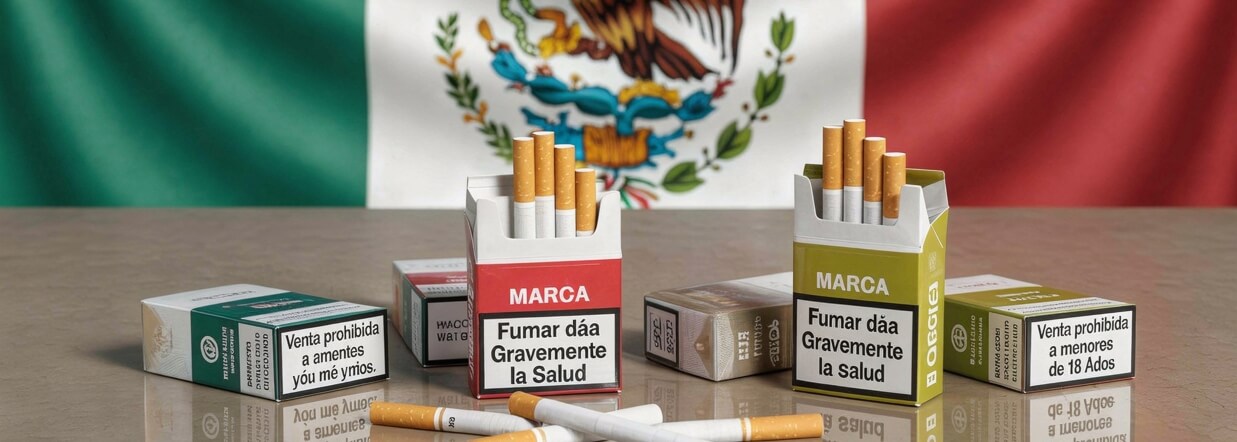
Mexico was the first country in the Americas to ratify the WHO Framework Convention on Tobacco Control in 2004. Two decades later, it has some of the region’s strictest tobacco regulations.
Mexico Cigarette Packaging Requirements
Mexico requires graphic health warnings covering 30% of the front and 100% of the back of cigarette packages. Warnings rotate frequently – the country has implemented 14 rounds of picture warnings since 2010, changing every 6 to 12 months.
In 2020, Mexico became the first country to include a COVID-19 warning on cigarette packages, noting that tobacco use could increase infection risk.
Current warning rotation schedule:
Date | Event |
|---|---|
Sept 2024 – Dec 2024 | 3 warnings |
Jan 2025 – Jun 2025 | 4 warnings |
Jul 2025 – Dec 2025 | 4 warnings |
Jan 2026 – Jun 2026 | 4 warnings |
The 2022 Advertising Ban
In December 2021, Mexico’s Congress amended the General Tobacco Control Law to mandate a total ban on tobacco advertising, promotion, and sponsorship. The regulations took effect on January 15, 2023, and include:
- All tobacco advertising in any media prohibited
- Social media promotion and influencer marketing banned
- All tobacco displays at retail points of sale prohibited
- Sponsorship by tobacco companies banned
- Subliminal advertising in television and film prohibited
Restaurants and bars cannot serve food or beverages to customers while smoking. The regulations apply to both traditional Mexican cigarettes and vaping devices.
Plain Packaging Status
Mexico has not yet adopted plain packaging, though several bills have been introduced. The Pan American Health Organization continues to provide technical assistance to Mexican legislators working on standardised packaging proposals.
🇧🇷 Brazil: Pioneering Graphic Warnings in Latin America

Brazil became the second country in the world, and the first in Latin America, to require graphic picture warnings on cigarette packages in 2002, just one year after Canada.
Brazil Tobacco Labels Today
Brazilian cigarette packages carry graphic warnings covering 100% of the back panel. Combined with 30% coverage on the front, Brazil achieves 65% average coverage of the principal display areas.
The current batch of seven warnings, introduced in 2018, includes images depicting:
- Lung damage
- Oral cancer
- Heart disease
- Harm to children from secondhand smoke
- Pregnancy complications
A new round of warnings was implemented in 2025.
Required Constituent Statement
Since 2003, all Brazilian cigarette packages must display the following statement:
“Este produto contém mais de 4,7 mil substâncias tóxicas, e nicotina que causa dependência física ou psíquica. Não existem níveis seguros para consumo dessas substâncias.”
(This product contains over 4,700 toxic substances and nicotine, which causes physical or psychological addiction. There are no safe levels for consuming these substances.)
Plain Packaging Consideration
Brazil has considered plain packaging legislation, with draft bills introduced in the National Congress. However, as of late 2025, no plain packaging law has been enacted. The country’s 2025 FCTC implementation report indicates plain packaging remains under review.
Tracking and Tracing
Brazil operates a robust tobacco tracking system. According to its 2025 Protocol implementation report:
- 171.3 million cigarette packs seized in 2023
- 153.5 million packs seized in 2024
- Unique identification markings required on all domestically manufactured and imported cigarettes
- Online tobacco retail sales banned
🇺🇾 Uruguay: First in Latin America with Plain Packaging

Uruguay has earned a reputation as Latin America’s tobacco control leader. In 2019, it became the first country in the region to require plain packaging, and it pairs this with the world’s only “single presentation” rule.
The Vázquez Legacy
Former President Tabaré Vázquez, an oncologist, launched Uruguay’s tobacco control revolution in 2006 during his first term. The initial measures included:
- 100% smoke-free public places
- 80% graphic health warnings (then world’s largest)
- Complete ban on tobacco advertising, promotion, and sponsorship
In 2009, Uruguay increased warning size to 80% of both front and back – a global record at the time.
Plain Packaging Implementation
Uruguay’s plain packaging regulations, enacted in December 2019, require:
- Uniform drab brown colour for all tobacco packs
- Standard lettering with no brand logos or trademarks
- Health warnings covering 80% of the total surface
- Single presentation requirement – only one variant per brand family
The single presentation rule means tobacco companies cannot sell multiple versions of the same brand (such as Marlboro Red, Marlboro Light, Marlboro Gold). This eliminates a key marketing tactic used to suggest some cigarettes are less harmful than others.
Victory Over Philip Morris
In 2016, Uruguay won a landmark case at the International Centre for Settlement of Investment Disputes (ICSID). Philip Morris International had argued that Uruguay’s large graphic warnings and single presentation rule violated trademark protections under a bilateral investment treaty.
The tribunal rejected all of Philip Morris’s claims after six years of litigation. Uruguay’s legal fees amounted to approximately $10 million – costs that could deter smaller countries from implementing similar measures.
Current Warning Requirements
Specification | Requirement |
|---|---|
Warning size (front) | 80% |
Warning size (back) | 80% |
Number of warnings | 8 |
Plain packaging | Required |
Single presentation | Required |
🇨🇱 Chile: Steady Progress Over Two Decades
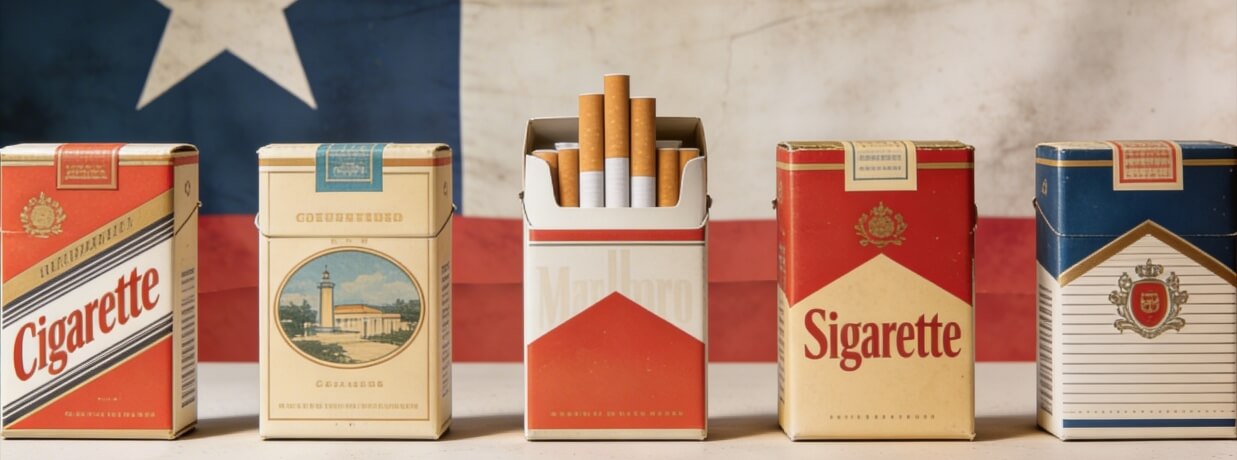
Chile has implemented 12 rounds of graphic health warnings since 2006, demonstrating sustained commitment to tobacco control despite not yet adopting plain packaging.
Current Labelling Requirements
Chilean cigarette packages require graphic warnings covering 50% of both front and back panels. The country uses eight warnings that rotate periodically.
Warning rounds:
- 2006–2015: Single warning displayed at a time, changed annually
- 2013 onwards: Multiple warnings displayed concurrently
- 2025: Latest round of eight warnings
Chile’s 2025 FCTC implementation report indicates plain packaging is a priority, though no legislation has been enacted.
Industry Opposition
Like other Latin American countries, Chile has faced tobacco industry opposition to stronger packaging measures. Draft plain packaging bills have been introduced but delayed or withdrawn under industry pressure.
Regional Comparison: Americas Tobacco Labelling
Country | Warning Size | Warning Size | Graphic Warnings | Warnings on Cigarettes |
|---|---|---|---|---|
Canada | 75% | Yes (2020) | Yes (2001) | Yes (2024) |
United States | ~8% (side) | No | No | No |
Mexico | 65% avg | No | Yes (2010) | No |
Brazil | 65% avg | No | Yes (2002) | No |
Uruguay | 80% | Yes (2019) | Yes (2006) | No |
Chile | 50% | No | Yes (2006) | No |
Countries Considering Plain Packaging
According to the Canadian Cancer Society’s 2025 report, several countries in the Americas are formally considering plain packaging:
- 🇨🇴 Colombia
- 🇨🇷 Costa Rica
- 🇵🇦 Panama
- 🇲🇽 Mexico
How the Americas Compare Globally
The Americas region includes both global leaders and laggards in tobacco labelling:
Global leaders from the Americas:
- Canada ranks 18th worldwide for warning size (75%)
- Uruguay ranks 14th (80%)
Regional challenges:
- United States ranks 173rd (tied for last)
- Several Caribbean nations have no picture warnings
The Canadian Cancer Society’s October 2025 report documents 25 countries in the Americas with picture warning requirements, including Argentina, Bolivia, Brazil, Canada, Chile, Colombia, Costa Rica, Ecuador, El Salvador, Guyana, Honduras, Jamaica, Mexico, Nicaragua, Panama, Paraguay, Peru, Saint Lucia, Suriname, Trinidad and Tobago, Uruguay, and Venezuela.
Tobacco Industry Tactics in the Region
A 2022 Pan American Journal of Public Health analysis documented industry strategies to oppose standardised packaging in the Americas:
Legal challenges: Tobacco companies have filed lawsuits arguing that plain packaging violates trademark protections and international trade agreements. Philip Morris’s case against Uruguay lasted six years before being dismissed.
Economic arguments: Industry groups claim plain packaging increases counterfeiting and harms retailers. Independent research has consistently debunked these claims.
Political lobbying: In countries including Brazil, Chile, Costa Rica, Ecuador, Mexico, and Panama, draft plain packaging bills have been delayed or withdrawn following industry opposition.
The analysis concludes that governments should follow the examples of Canada and Uruguay, which rejected industry arguments and won all legal challenges.
What’s Coming Next
Several developments are expected in the Americas tobacco labelling landscape:
🇨🇦 Canada: New placement for health information messages on cigarette package slide-flaps required by July 2026.
🇺🇸 United States: Ongoing litigation will determine whether graphic warnings can be implemented. If courts uphold the FDA rule, enforcement could begin in late 2025 or 2026.
🇲🇽 Mexico: Additional restrictions on vaping products and potential plain packaging legislation under consideration.
🌎 Latin America: More countries likely to implement plain packaging following the WTO’s 2018 ruling in favour of Australia and Uruguay’s ICSID victory.
We are not affiliated with any government agency, regulatory authority, tobacco manufacturer, or health organization mentioned on this page. All country references, legal summaries, statistics, and timelines are based on official legislation, regulatory documents, WHO publications, and publicly accessible reports as of 2026.