
Tobacco Labels in Europe: EU Directive and Country Rules
European tobacco packaging looks nothing like it did a decade ago. Graphic warnings now cover most of every cigarette pack. Plain packaging has spread across the continent. France just banned smoking in parks and near schools. The EU aims to have less than 5% of its population using tobacco by 2040.
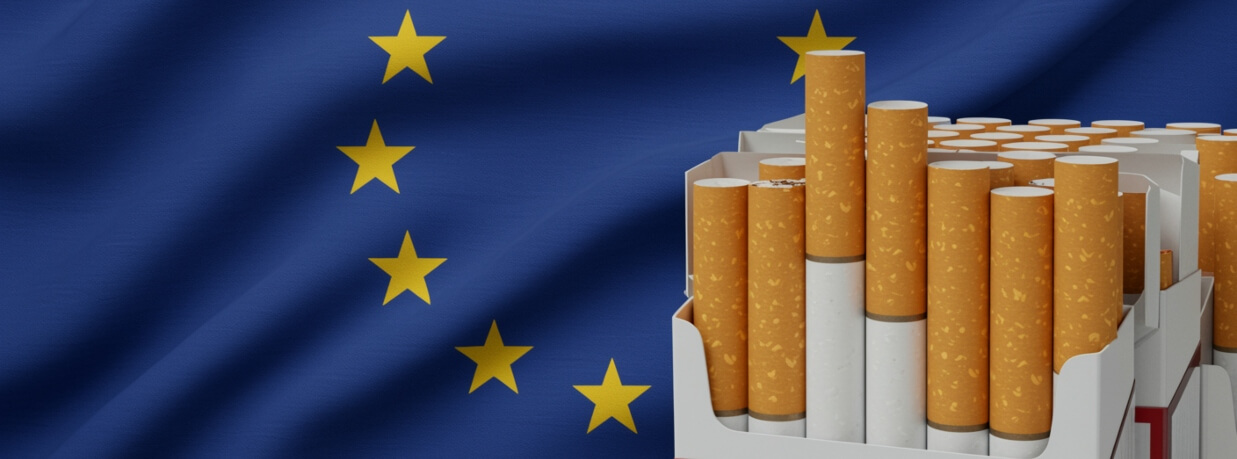
The EU Tobacco Products Directive: Foundation of European Rules
The EU Tobacco Directive (2014/40/EU) sets the baseline for European tobacco packaging across all 27 member states. Proposed by the European Commission in December 2012, adopted in March 2014, and fully applicable since May 2016, this directive transformed how tobacco products appear on European shelves.
What the Directive Requires
Every cigarette pack and roll-your-own tobacco pouch sold in the EU must display combined health warnings, both text and graphic images, covering 65% of the front and back of the package.
The directive specifies three series of 14 European cigarette warnings that rotate every 12 months. Each warning combines a colour photograph with text in the official language(s) of the member state where the product is sold.
Key provisions of the EU tobacco directive:
Requirement | Specification |
|---|---|
Warning coverage | 65% front and back |
Warning type | Combined text + picture |
Number of warnings | 3 series of 14 |
Rotation | Every 12 months |
Quitline information | Required |
Misleading elements | Prohibited |
Beyond health warnings, the directive bans characterizing flavours, including menthol, which was prohibited across the EU from May 2020. It also prohibits promotional or misleading elements on packaging and establishes an EU-wide tracking system to combat illicit trade.
Products Covered
The directive applies to:
- Cigarettes
- Roll-your-own tobacco
- Pipe tobacco
- Cigars and cigarillos
- Smokeless tobacco
- Electronic cigarettes and refill containers
- Herbal products for smoking
For e-cigarettes, the directive caps nicotine concentration at 20 mg/ml, limits tank capacity to 2 ml, and restricts refill containers to 10 ml. All nicotine-containing products must be child-resistant and tamper-evident.
Where the Directive Falls Short
The 2025 WHO/Europe report on tobacco control identifies significant gaps in how EU member states have implemented the directive:
- Only 8 of 27 countries have achieved fully smoke-free environments
- Only 4 countries have comprehensive bans on advertising, promotion, and sponsorship
- Only 6 countries have banned e-cigarette flavours
- In 14 countries, cigarettes have actually become more affordable since 2014
Perhaps most concerning: nearly one in four 15–16-year-olds across the EU now uses e-cigarettes, with rates ranging from 6% in Portugal to 36% in Poland. Since 2019, adolescent e-cigarette use has increased in 22 of 25 EU countries studied, and in every member state, girls report higher use than boys.
Revision on the Horizon
The European Commission has signalled that revisions to the Tobacco Products Directive are coming. Key areas under consideration include:
- Extending plain packaging requirements to all nicotine products
- Banning all flavours in vaping products
- Closing loopholes in online advertising
- Strengthening tax harmonisation
The goal: a “tobacco-free generation” by 2040, defined as less than 5% of the population using tobacco.
🇬🇧 United Kingdom: Life After Brexit
The UK implemented the EU Tobacco Products Directive through the Tobacco and Related Products Regulations 2016 before leaving the European Union. These tobacco labelling regulations in the UK continue to shape packaging standards post-Brexit, though the country now has the flexibility to go further.
Current Packaging Requirements
UK cigarette warnings must cover 65% of the front and back of all cigarette and roll-your-own tobacco packages. These health warnings on cigarettes combine graphic images, text statements, plus the message “Get help to stop smoking at www.nhs.uk/quit.”
Plain packaging has been mandatory since May 2017. All cigarettes and roll-your-own tobacco must be sold in standardized drab brown packs (Pantone 448 C) with brand names displayed only in a specified font.
The Numbers Tell the Story
The UK’s smoking rate has dropped to approximately 12% – the lowest on record. But the picture is complicated by stark regional inequalities: in some areas, prevalence reaches 22%.
Research on the impact of standardized packaging shows remarkable changes in consumer perception:
Measure | Before (2016) | After (2018) |
|---|---|---|
Disliked pack appearance | 16% | 53% |
Noticed warnings first | 24% | 52% |
Supported the law | 32% | 44% |
Young people’s reactions have been particularly notable. Studies found that both smokers and non-smokers aged 11-18 found standardized packs unattractive, with new health warnings producing “aversive responses.”
The Cigarillo Loophole
While cigarettes face strict regulation, other tobacco products have exploited gaps in the rules. Non-cigarette tobacco use in England has risen fivefold over the past decade, with approximately 772,800 adults now exclusively smoking products like cigars, pipes, or shisha.
The most controversial loophole involves cigarillos. When menthol cigarettes were banned in May 2020, both Japan Tobacco International and Imperial Brands launched mentholated cigarillos that closely resemble cigarettes but avoid the ban because they’re wrapped in tobacco leaf rather than paper.
These products can be sold in packs of 10 for around £6.90, about half the price of 20 cigarettes, and an estimated one million adults still smoke menthol products in Great Britain despite the prohibition.
What’s Coming Next
The UK government is pursuing what it calls a “smoke-free generation” through the Tobacco and Vapes Bill. Key proposals include:
- Gradually raising the legal age to buy tobacco (so anyone born after a certain date can never legally purchase cigarettes)
- Extending smoke-free places to more outdoor areas
- Mandating pack inserts with quit information in all cigarette and RYO packaging
- Considering standardized packaging for all tobacco products, including cigars, cigarillos, pipe tobacco, waterpipe tobacco, chewing tobacco, and heated tobacco devices
A government call for evidence closed in January 2025, seeking input on extending plain packaging to these additional product categories.
Policymakers are also reviewing future updates to warning design, including potential new pictures on cigarette packets in the UK as part of ongoing public health reforms.
🇮🇪 Ireland: First in the EU with Plain Packaging
Ireland made history in 2015 when it became the second country in the world, and the first in the European Union, to pass plain packaging legislation. The reform built on earlier requirements for large graphic health warnings – often referred to as pictures on cigarette packs Ireland introduced as part of EU labelling rules. The law had cross-party support and passed parliament without a formal vote.
“We are creating legislation which will be historic and will be of real importance to the area of public health,” said Minister for Children James Reilly at the time. “We are on the verge of being the first country in the EU to pass a law on plain packaging.”
Ireland Plain Packaging: Implementation and Impact
Ireland plain packaging requirements took effect in September 2018 for manufacturers and retailers. All cigarettes and roll-your-own tobacco must now be sold in standardized drab brown packs with health warnings covering 65% of the front and back.
A 2025 evaluation published in Tobacco Induced Diseases examined consumer responses before and after implementation. The study found statistically significant changes across 7 of 13 measured outcomes:
- Product appeal: Decreased as expected
- Health warning effectiveness: Increased noticeably
- Perceived harm: No significant change
Crucially, the researchers found that plain packaging worked without exacerbating smoking inequalities between socioeconomic groups – a concern that had been raised during debates over the policy.
Tobacco Free Ireland 2025
Ireland set an ambitious target: reduce smoking prevalence to below 5% by 2025. A 2018 SimSmoke simulation predicted the country would miss this goal, and that prediction appears to have been accurate.
Several factors complicate Ireland’s tobacco control efforts:
Immigration patterns: Polish immigrants (Ireland’s largest non-Irish national group) have higher smoking rates than the general population. Lithuanian immigrants (the third largest group) come from a country where 38.1% of men and 22.2% of women smoke. Budget airline tickets to Poland or Lithuania cost as little as €19.99, giving immigrants easy access to cheaper cigarettes without plain packaging requirements.
Illicit trade: A 2016 government survey estimated Ireland’s illicit cigarette market exceeded 20 million packets per year. While tobacco industry estimates tend to overstate the problem, independent research suggests illicit cigarettes constitute about 4.9% of all manufactured cigarettes smoked in Ireland.
Border issues: The Northern Ireland border has historically been associated with smuggling, and political instability could exacerbate illicit tobacco trade.
The Human Cost
Tobacco kills approximately 5,600 people in Ireland each year. The economic cost of smoking is estimated at €2.826 billion annually.
🇫🇷 France: New Outdoor Smoking Bans
France has some of the strongest tobacco control policies in Europe, and they just got stronger. From 1 July 2025, smoking is banned in numerous outdoor public spaces where children and young people are present.
The 2025 Expansion
Health Minister Catherine Vautrin announced the new restrictions with a clear message: “Tobacco must disappear where there are children. The freedom to smoke ends where children’s right to breathe clean air begins.”
New smoke-free zones from July 2025:
- Public parks and gardens
- Beaches near bathing areas
- Bus shelters and covered passenger waiting areas
- Areas around schools, colleges, and high schools
- Surroundings of libraries, swimming pools, stadiums, and sports facilities
Violations can result in fines of €135.
France Cigarette Packs: Current Requirements
France was among the first EU countries to implement plain packaging, with requirements taking effect for manufacturers in May 2016 and at retail in January 2017.
All France cigarette packs must display:
- Graphic health warnings covering 65% of front and back
- Standardized drab brown colour (Pantone 448 C)
- Brand names in specified font only
- No logos, colours, or promotional imagery
Smoking Rates in Decline
French tobacco control efforts are showing results:
- Daily smoking rate: 23% of adults (lowest since the 1990s)
- Youth smoking: 16% of 17-year-olds (down from 25% six years ago)
- Public support for new restrictions: 78%
Yet the toll remains staggering. Tobacco kills approximately 75,000 people in France each year – more than 200 deaths per day. The societal cost is estimated at €150-156 billion annually.
Environmental impact is also significant: 20,000 to 25,000 metric tons of cigarette butts are discarded in France each year. Paris alone deals with 2 billion cigarette butts on its streets annually.
Additional Measures
France’s 2025 tobacco plan also includes:
- Reducing permitted nicotine levels in tobacco and vaping products
- Strict limits on vaping flavours (targeting candy and sweet flavours that appeal to youth)
- Complete ban on single-use electronic cigarettes (“puffs”)
The goal: a tobacco-free generation by 2032.
Other European Countries: Who Goes Further
While the EU tobacco directive sets the floor, many European countries have raised the bar with additional requirements.
Plain Packaging Across Europe
As of early 2026, 15 countries and territories in Europe have implemented standardized packaging:
Country | Manufacturers | Retail |
|---|---|---|
France | May 2016 | January 2017 |
United Kingdom | May 2016 | May 2017 |
Norway | July 2017 | July 2018 |
Ireland | September 2017 | September 2018 |
Slovenia | January 2020 | January 2020 |
Turkey | January 2020 | December 2020 |
Belgium | January 2020 | January 2021 |
Netherlands | October 2020 | October 2021 |
Denmark | July 2021 | April 2022 |
Guernsey | July 2021 | July 2022 |
Hungary | January 2022 | January 2022 |
Jersey | January 2022 | July 2022 |
Finland | May 2023 | May 2023 |
Georgia | March 2025 | April 2025 |
Iceland | May 2027 | May 2027 |
Turkey: Europe’s Largest Warnings
Turkey requires health warnings covering 92.5% of cigarette packages – the largest in Europe and second largest in the world (after Timor-Leste). Warnings cover 85% of the front and 100% of the back.
Combined with plain packaging requirements that took effect in December 2020, Turkish cigarette packs are among the most heavily regulated anywhere.
Norway and Switzerland: Non-EU Approaches
Norway is not an EU member but has aligned its tobacco regulations with EU standards through the EEA Agreement. Plain packaging has been required since July 2018. Interestingly, Norway’s average warning coverage (48%) is actually below the EU minimum, though this reflects how coverage is calculated rather than weaker protections.
Switzerland has historically lagged behind EU standards but is gradually strengthening its regulations. Warning coverage is 56%, and the country has implemented graphic warnings. However, Switzerland has not adopted plain packaging.
Belgium: Multilingual Warnings
Belgium presents unique challenges as a country with three official languages. All tobacco packaging must display warnings in Dutch, French, and German, with warnings covering 56% of the total surface area – slightly below the EU minimum of 65% for front and back.
The Baltic States
Latvia was among the early adopters of graphic warnings in Europe (2010) and serves as an example of consistent implementation. Like other EU members, Latvia follows the TPD requirements with 65% warning coverage.
EU vs Non-EU: What’s the Difference?
European tobacco packaging falls into three broad categories: EU member states bound by the Tobacco Products Directive, non-EU countries that have aligned with EU standards, and countries that have gone their own way.
EU Member States (27 countries)
All must meet TPD minimums:
- 65% combined warnings (front and back)
- Graphic images plus text
- Characterising flavour ban (including menthol)
- Track and trace system
- E-cigarette restrictions (20 mg/ml nicotine cap, 2 ml tank limit)
Aligned Non-EU Countries
Norway, Iceland, Liechtenstein: Follow EU standards through EEA Agreement
United Kingdom: Post-Brexit, maintains TPD-equivalent standards with flexibility to exceed them
Switzerland: Partially aligned, moving toward EU standards
Countries with Stronger Requirements
Several European countries exceed TPD minimums:
Country | Additional Measures |
|---|---|
Turkey | 92.5% warnings, plain packaging |
Norway | Plain packaging |
Ireland | Plain packaging (first in EU) |
France | Plain packaging, extensive outdoor bans |
UK | Plain packaging, potential age restrictions |
Finland | Plain packaging |
Belgium | Plain packaging |
Netherlands | Plain packaging |
Denmark | Plain packaging |
Hungary | Plain packaging |
Slovenia | Plain packaging |
Eastern Europe and Non-EU States
Countries outside the EU have varying approaches:
- 🇷🇺 Russia: 50% warnings, no plain packaging
- 🇧🇾 Belarus: 50% warnings, no plain packaging
- 🇺🇦 Ukraine: 65% warnings, no plain packaging
- 🇬🇪 Georgia: 65% warnings, plain packaging from 2025
- 🇲🇩 Moldova: 65% warnings, no plain packaging
The Bigger Picture: Half a Million Deaths Each Year
Despite two decades of tobacco control progress, the burden remains immense. The EU tobacco directive has transformed packaging across the continent, but tobacco still kills more than 500,000 Europeans every year. Another 80,000 die from second-hand smoke exposure.
The WHO/Europe report released in November 2025 puts these numbers in stark perspective:
- 26.5% of EU adults use tobacco (vs 20.9% globally)
- Nearly 1 in 4 women in the EU smokes (vs 7.4% globally)
- Tobacco causes 17% of all premature deaths from noncommunicable diseases
- Only 7 of 27 EU countries are on track to meet the WHO target of 30% reduction in tobacco use by 2025
The rise of e-cigarettes among young people threatens decades of progress. Studies show that e-cigarette use can increase conventional cigarette uptake among nonsmoking youth by nearly three times.
Industry Interference Persists
The WHO/Europe report identifies tobacco industry interference as a persistent obstacle. From funding research that underestimates illicit trade to lobbying against plain packaging, the industry continues to resist effective tobacco control measures.
Article 5.3 of the WHO Framework Convention on Tobacco Control requires governments to protect health policy from industry influence. Implementation remains uneven across Europe.
What Would Make a Difference
WHO/Europe recommends several priority actions:
- Revise the TPD to close regulatory gaps and extend plain packaging to all nicotine products
- Ban all flavours in e-cigarettes and vaping products
- Strengthen taxation and prevent cigarettes from becoming more affordable
- Expand smoke-free environments following France’s lead
- Close online advertising loopholes
The goal, a tobacco-free Europe with less than 5% prevalence by 2040, is achievable. But as the WHO report concludes, it requires “stronger collective action” from all member states.