
Tobacco Labels in the Middle East and Africa: What’s on the Pack
The Middle East defies easy categorization when it comes to tobacco control. Turkey mandates the world’s second-largest health warnings. The GCC countries are building unified regional standards. Iran bans e-cigarettes entirely but struggles with illicit trade. And across Africa, a handful of pioneers are adopting plain packaging while most nations are still working on basic warning requirements.
Here’s what cigarette packs look like across this diverse region.
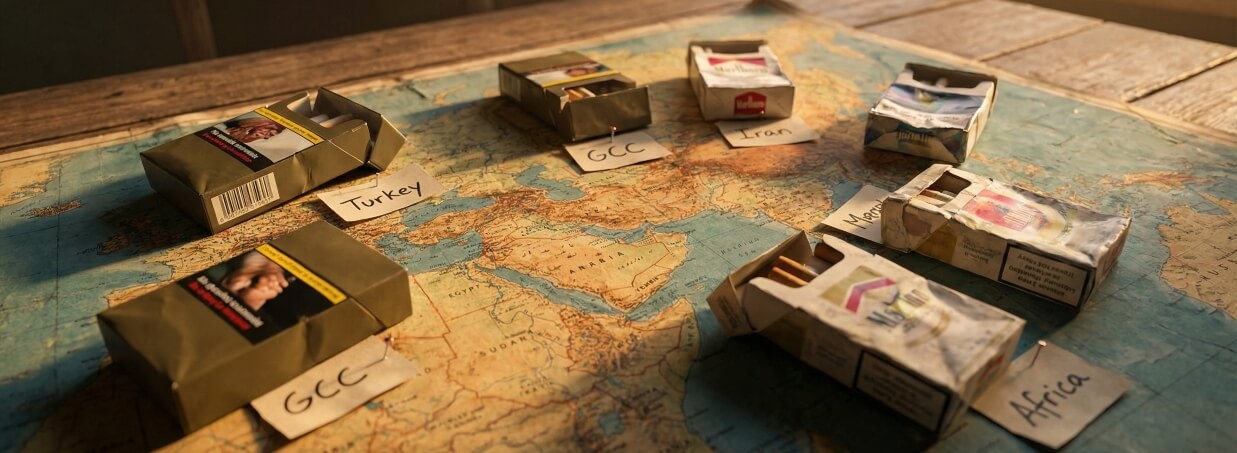
🇹🇷 Turkey: Giant Warnings, Zero Brand Appeal
Turkey doesn’t do half-measures. With health warnings covering 92.5% of cigarette packaging, 85% of the front and the entire back, only Nepal exceeds Turkey’s requirements globally.
Turkey Plain Packaging in Practice
The regulations that came into force in December 2019 (for manufacturers) and December 2020 (for retailers) stripped tobacco products of nearly all branding:
- Drab, standardized pack colours
- Brand names limited to 5% of one side panel
- No logos, symbols, or brand imagery permitted
- Hookah bottles included under the same rules
Beyond packaging, Turkey bans tobacco product images in movies, television programmes, music videos, and social media used for commercial purposes. The comprehensive approach reflects Turkey’s position as a bridge between European and Middle Eastern tobacco control frameworks.
The country’s 2018 legislation stated its rationale clearly: tobacco products will be sold in plain, standardized packages “to eliminate the tempting features of the marks and packages.”
The GCC: Six Countries, One Direction
The Gulf Cooperation Council (Bahrain, Kuwait, Oman, Qatar, Saudi Arabia, and the United Arab Emirates) represents a unique experiment in coordinated regional tobacco control. All six nations ratified the WHO FCTC by August 2006, and they’ve been aligning policies ever since.
Gulf Tobacco Regulations Today
The GCC countries share cultural, economic, and religious contexts that shape their approach to tobacco. Islam doesn’t explicitly forbid tobacco use but encourages preservation of health – a principle that informs regional policy discussions.
Current smoking prevalence varies significantly:
Country | Adult Smoking Rate |
|---|---|
Kuwait | 19.3% |
Bahrain | 19.0% |
UAE | 15.2% |
Qatar | 12.1% |
Saudi Arabia | 11.6% |
Oman | 7.8% |
The economic burden tells another story: smoking and secondhand smoke cost GCC countries an estimated $34.5 billion in 2016.
Saudi Cigarette Warnings and Plain Packaging
Saudi Arabia and the UAE have moved furthest, implementing plain packaging as part of a coordinated GCC initiative. Saudi cigarette warnings now appear on standardized packs stripped of brand imagery, with health messages dominating the visible surfaces.
Both countries introduced digital tax stamps as part of the plain packaging rollout, creating track-and-trace systems to combat illicit trade while ensuring tax compliance.
What All GCC Countries Require
Despite variations, certain measures are universal across the Gulf:
- Complete smoking bans in public workplaces
- Minimum age of 18 for tobacco purchases
- Health warnings on all tobacco packaging
- Restrictions on tobacco advertising
- Bans on tobacco sales to minors
However, implementation depth varies. Bahrain and Qatar have implemented FCTC measures most comprehensively, while Kuwait and Oman have adopted fewer provisions. Smoking restrictions in restaurants remain partial in several countries, and private vehicle smoking bans are inconsistent.
E-Cigarette Regulation Coming
In January 2025, the GCC Standardization Organization approved a final draft standard for e-liquids, complementing existing regulations on electronic devices. Once adopted (expected mid-2025), this will require all GCC members to implement unified rules including:
- Bans on certain flavours (cocoa, vanilla, coffee, candy, cola, alcohol)
- Expanded e-liquid standards
- Comprehensive health warnings stating products “may pose a health hazard when inhaled, swallowed, or in contact with skin”
Notably, Oman and Qatar, which currently ban e-cigarettes, participated in the voting process, suggesting potential future policy shifts.
🇮🇷 Iran: Strict Bans, Persistent Challenges
Iran tobacco packaging regulations present an unusual profile: comprehensive bans on most tobacco alternatives alongside ongoing enforcement challenges.
What’s Banned
Iran has prohibited:
- Smokeless tobacco products
- E-cigarettes (ENDS)
- Non-nicotine vaping devices (ENNDS)
- Heated tobacco products
- Nicotine pouches
These products are illegal to import, sell, buy, or market. Online sales are banned. Advertising is prohibited across all media.
What’s Permitted
Cigarettes and waterpipe tobacco remain legal. Cigarettes are fully regulated with testing requirements for contents and emissions, mandatory health warnings, and sales restrictions. Waterpipe tobacco is partially regulated – available legally but subject to fewer controls.
The Reality on the Ground
Despite strict bans, smokeless products like Pan, Gutka, Nass, Naswar, and Supari remain available through illicit channels. Government estimates put illicit tobacco at 15% of the market (2023 data).
Iran’s 2025 FCTC report acknowledges plain packaging as a barrier to full implementation, citing “constraints and barriers related to individual articles” specifically referencing Article 11 guidelines on standardized packaging.
Recent progress includes:
- New 7-year strategic tobacco control plan (2024-2030)
- Excise taxes on tobacco in the 7th National Development Plan
- Minimum 20 cigarettes per pack requirement
- Ban on single cigarette sales
- Fully equipped tobacco control laboratories in Tehran
Iran’s government expenditure on tobacco control reached approximately $1.07 million in 2024 – significant for the region but modest given the country’s population.
African Progress: Pioneers and Potential
Africa’s tobacco control landscape is developing rapidly, though from a lower baseline than other regions.
Plain Packaging Adopters
Two African nations have joined the global plain packaging movement:
Mauritius: Implemented plain packaging in March 2023, becoming one of the first African countries to do so. Tobacco products must now appear in standardized packaging with prominent health warnings.
Côte d’Ivoire: Scheduled to implement plain packaging by December 2025, joining the growing list of African nations moving beyond basic warning requirements.
Regional Challenges
Most African countries face competing public health priorities, limited enforcement capacity, and significant tobacco industry presence. However, WHO FCTC ratification across the continent provides a framework for progressive strengthening of tobacco control measures.
South Africa has legislation in progress but faces delays. Many nations are focusing on foundational measures, smoke-free policies, basic health warnings, and sales restrictions to minors, before considering plain packaging.
Regional Comparison at a Glance
Country/Region | Warning Size | Plain Packaging | Key Feature |
|---|---|---|---|
Turkey | 92.5% | Yes | Second-largest warnings globally |
Saudi Arabia | Varies | Yes | Digital tax stamps |
UAE | Varies | Yes | GCC coordination |
Iran | Required | No | Comprehensive alternative bans |
Mauritius | Required | Yes | First African adopter |
Other GCC | Varies | No | Moving toward coordination |
What Works, What Doesn’t
Evidence from across the Middle East and Africa suggests consistent patterns:
Effective approaches:
- Regional coordination (GCC model)
- Combining plain packaging with track-and-trace systems
- Comprehensive bans backed by enforcement resources
- Firm implementation deadlines
Ongoing challenges:
- Illicit trade undermining legal market controls
- Inconsistent enforcement across jurisdictions
- Waterpipe and shisha regulation gaps
- Cross-border purchasing from lower-price neighbours
The GCC’s coordinated approach offers a model for other regions. When neighbouring countries align policies, they reduce incentives for cross-border smuggling and create consistent public health messaging.
This guide is maintained as an independent educational resource. Information compiled from official government sources, WHO reports, and regional health organisations.